
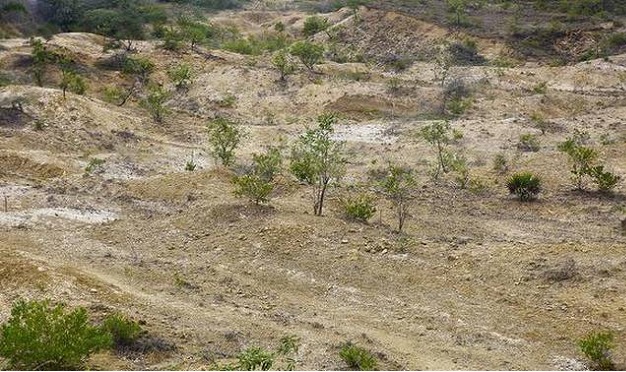
The Karai Badlands is one of India’s most significant yet lesser-known geo-heritage sites, located in Alathur taluk of Perambalur district, Tamil Nadu.
Karai Badlands During the Cretaceous Period
During the Cretaceous period, the Karai region was submerged under a shallow tropical sea. At that time, large parts of present-day Tamil Nadu were underwater, supporting rich marine ecosystems. Corals flourished, and marine organisms such as ammonites, belemnites, gastropods, and other invertebrates thrived in these warm seas.
The sediment deposited during this period gradually hardened into fossil-bearing rock layers, preserving a detailed snapshot of prehistoric marine life.
Mass Extinction and the Drying of the Ancient Sea
Around 66 million years ago, a massive asteroid impact triggered a global mass extinction event, wiping out dinosaurs and countless marine species. The Karai region was deeply affected by this planetary catastrophe.
Following the extinction, the shallow sea covering Karai gradually evaporated and retreated. The remains of dead marine organisms were buried under sediments and, over millions of years, transformed into fossils.
Fossils found in the Karai Badlands include:
- Ammonites
- Belemnites
- Corals
- Gastropods
- Other marine invertebrates
Landscape Formation by the Kundiyar River
The dramatic appearance of the Karai Badlands today is largely due to prolonged erosion by the Kundiyar River. Over geological timescales, flowing water carved through fossil-rich sedimentary layers, creating the characteristic mounds, ridges, and valleys seen today.
This erosion exposed ancient fossil beds, effectively turning Karai into a natural open-air geological museum.
Geo-Heritage Significance of Karai Badlands
The Karai Badlands holds exceptional importance as a geo-heritage site because it documents:
- South India’s ancient marine history
- The impact of global mass extinction events
- Long-term river erosion and landscape evolution
- Well-preserved marine fossils in situ
Such sites are crucial for geological research, education, and understanding Earth’s dynamic past.
Need for Conservation and Protection
Despite its scientific and educational value, the Karai Badlands remains largely unprotected and under-recognized. Unregulated fossil collection, vandalism, and lack of awareness pose serious threats to this fragile landscape.
Recognizing Karai Badlands as a protected geo-heritage monument would help preserve its fossils and landforms for future generations. Conservation efforts can also promote sustainable geo-tourism, benefiting local communities while safeguarding the site.
Conclusion
The Karai Badlands of Perambalur is a rare geological treasure that tells a story of ancient seas, catastrophic extinction, and slow natural sculpting by rivers. Protecting such geo-heritage sites is essential not only for science but also for preserving India’s deep natural history.
Karai stands as a powerful reminder that the land we walk on today was once an ocean floor, shaped by forces far older than humanity itself.
Some Links to related tweets from reliable sources are given below
https://x.com/TNGeography/status/2000041842256351689
https://x.com/TNGeography/status/2000044924721594555
https://x.com/TNGeography/status/2000048210690412763


